
Triumph
and
Grace
Women and Smoking
It may be difficult to imagine that 100 years ago it was quite scandalous, and in some cases illegal, for women to smoke, especially in public.
It was a man’s habit, one that greatly increased following World War I, where cigarettes were given to the soldiers for stress relief.
The tobacco companies, not satisfied with the increased sales to returning soldiers, sought to entice women to smoke as well. Given the social taboo, they needed help with the concept.
For this, they enlisted the services of public relations and propaganda expert, Edward Bernays, nephew of psychoanalyst Sigmund Freud.
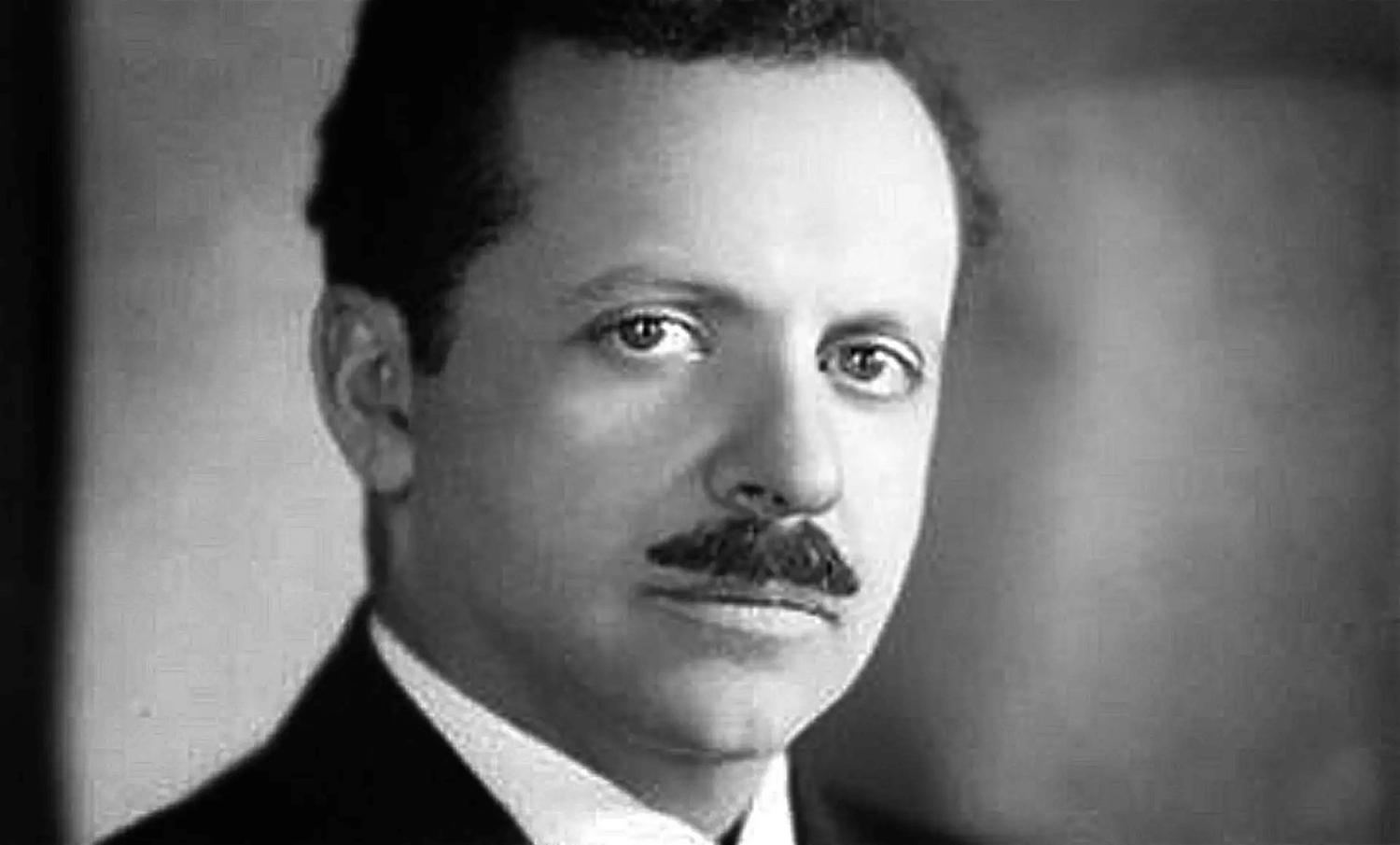
Labeled the father of public relations, Edward Bernays understood much about human psychology, and combined with his uncle's theories about unconscious desires, this made him extraordinarily effective at manipulating public opinion.
During World War I, Bernays had worked for the U.S. government to help convince Americans that entering the war would bring democracy to Europe.
Bernays believed that people were fundamentally irrational and could be easily influenced through emotional appeals rather than logical arguments.
He wrote, "We are governed. Our minds are molded, our tastes formed, our ideas suggested largely by men we have never heard of."
This philosophy drove his numerous commercial campaigns, including the famous American Tobacco Company [ATC] effort to get women to smoke.
In those years the zeitgeist was heady. World War I had brought women into the workforce in unprecedented numbers. In 1920, women got the right to vote in the United States and elsewhere. The Roaring Twenties saw dramatic changes in fashion, music, and entertainment. Prohibition led to underground speakeasies.
In 1928, as Bernays advised the ATC president George Washington Hill, the key to the new gold mine of sales to women was to make cigarettes a symbol of freedom.
Bernays didn't just want to advertise cigarettes to women – he wanted to fundamentally change how society viewed women smoking. To do this, he consulted with prominent psychoanalyst A.A. Brill, who had translated Freud's work into English.
Brill suggested that since smoking was a symbol of male power and sexuality, women could claim that power for themselves by smoking. The cigarette could become a symbol of challenging male dominance.
This led Bernays to link cigarettes with the women's suffrage movement and the fight for equal rights. If he could make smoking seem like an act of liberation rather than rebellion, he could transform the public's perception overnight.
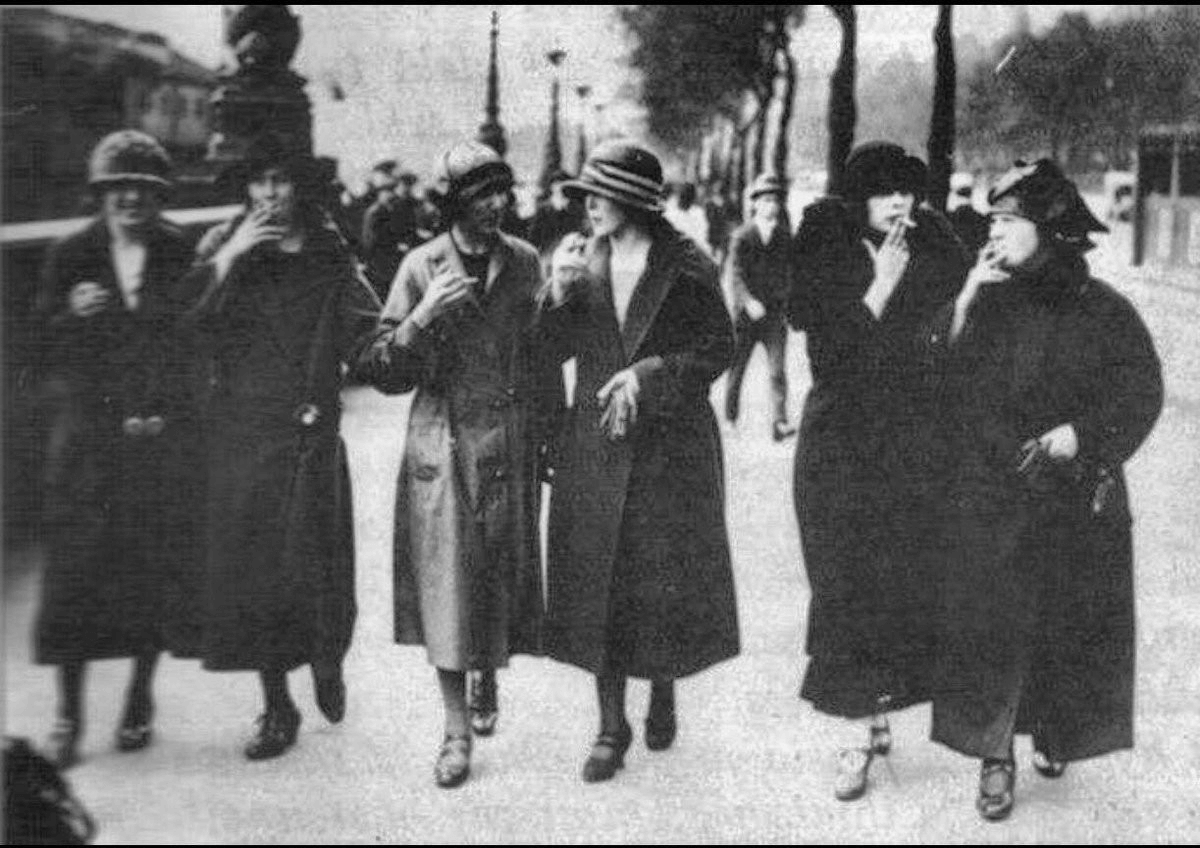
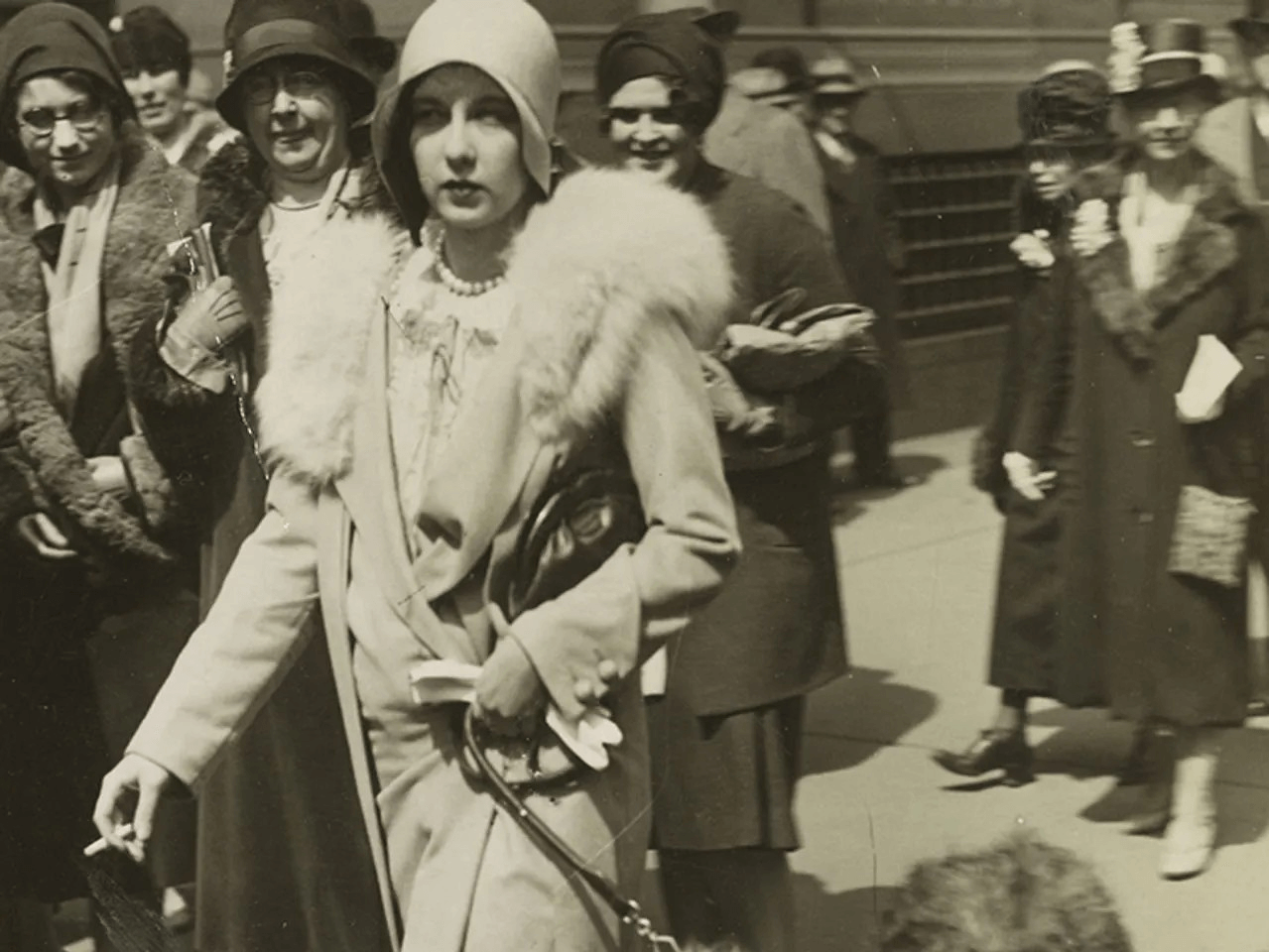
The Torches of Freedom campaign launched on Easter Sunday 1929, during New York City's Fifth Avenue Easter Parade [running since 1870]. Using careful choreography and planning, Bernays had recruited attractive and stylish debutantes, including his own secretary Bertha Hunt, to participate in what would become one of the most famous public relations stunts.
The women were briefed on every detail: which churches they would meet at, what they would say to the press, and how they would present their actions. Bernays had tipped off the media in advance, telling them that several suffragettes were planning to light up torches of freedom to protest discrimination against women.
As the women lit their Lucky Strike cigarettes and strolled down Fifth Avenue, photographers captured every moment. Bertha Hunt told reporters, I hope that we have started something and that with these torches of freedom, with no particular brand favored, we will smash the discriminatory taboo on cigarettes for women.
The plan succeeded beyond Bernays' wildest expectations. The story was covered in New York and by newspapers all around the world.
The taboo was shattered immediately. Within weeks, smoking became socially acceptable for women, and cigarette sales to women surged.
From there, the cigarette companies ran with it:
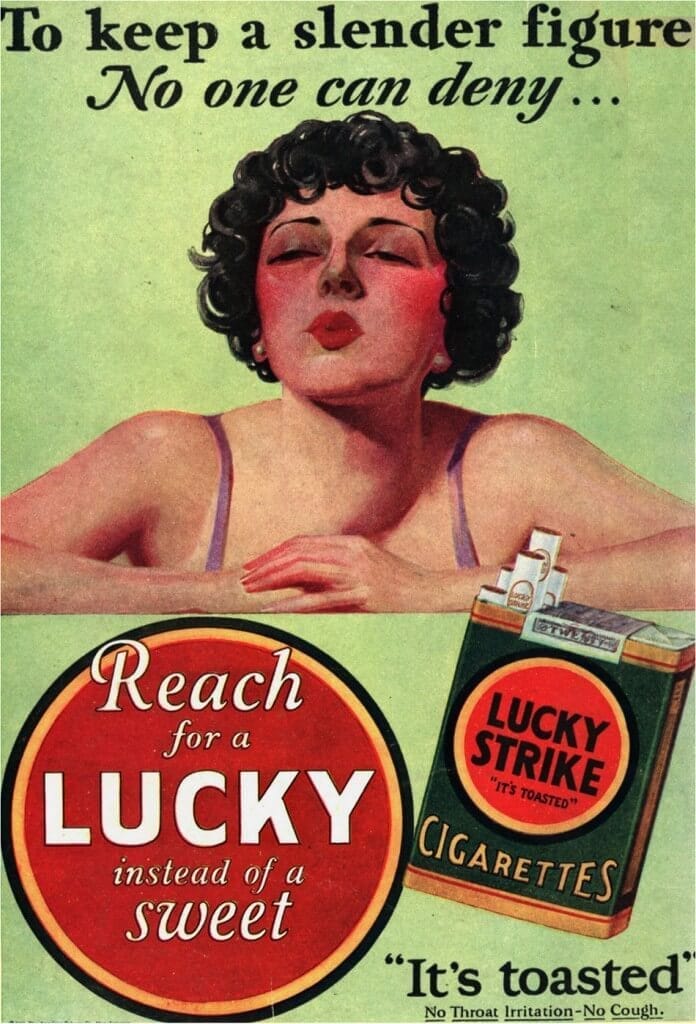
Reach for a Lucky Instead of a Sweet encouraged women to smoke to stay slender.
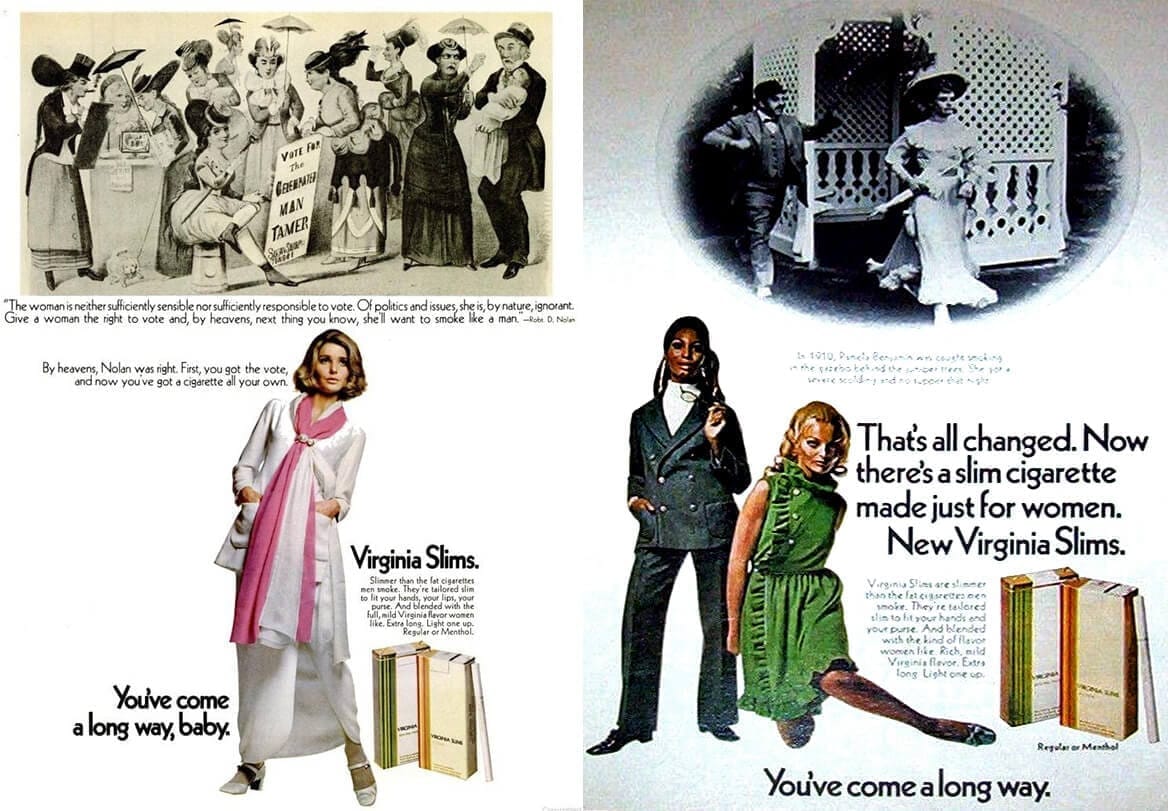
Virginia Slims ads in the 1960s told women: You’ve come a long way, baby.
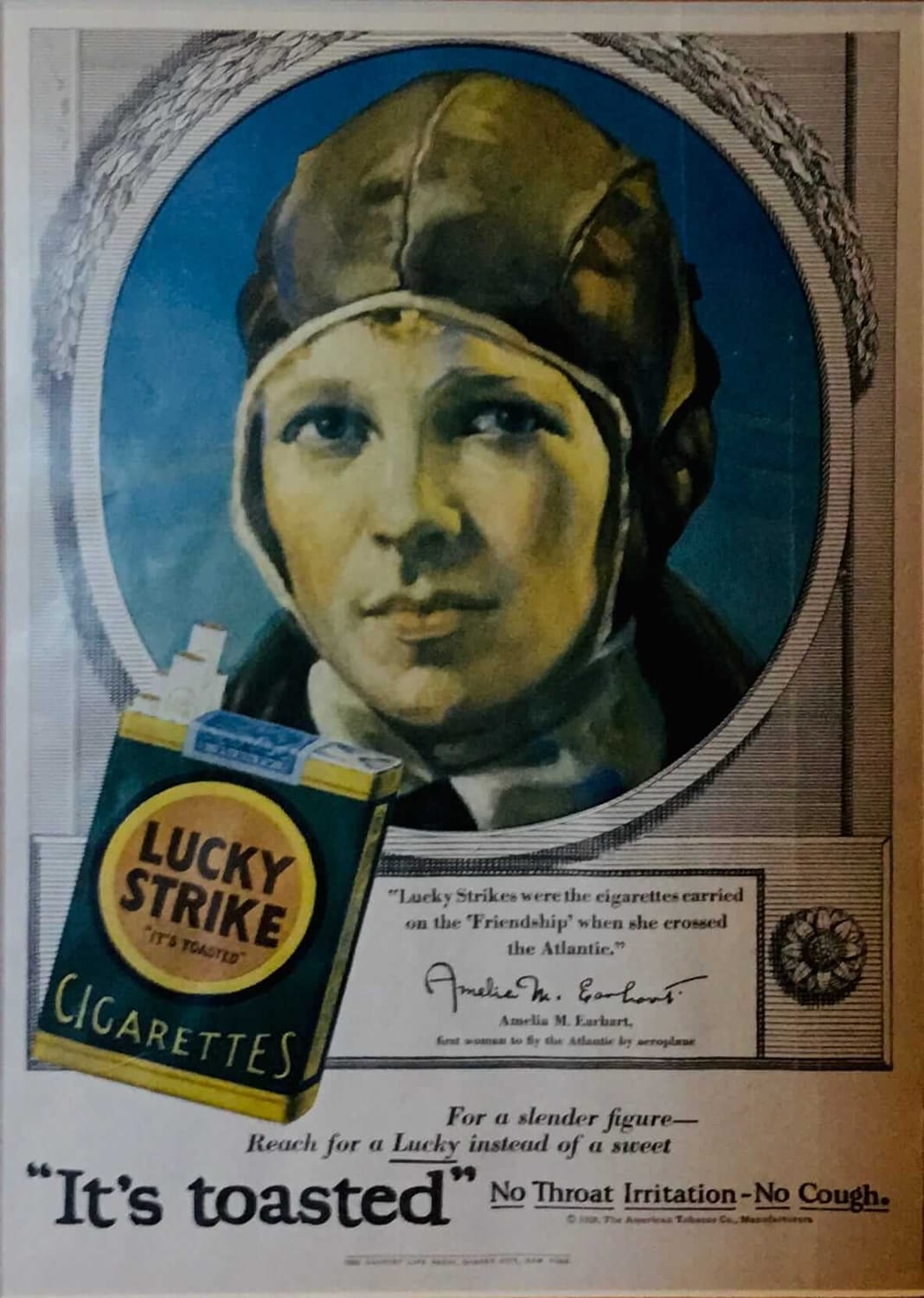
Female pilots and adventurers like Amelia Earhart were photographed with cigarettes, linking smoking to courage and modernity.
To overcome women’s dislike of the Lucky Strike green packaging, Bernays also:
Convinced fashion designers to make the same green the fashionable color of the season.
Organized a "Green Gala" at the Waldorf Astoria featuring society's elite in green attire.
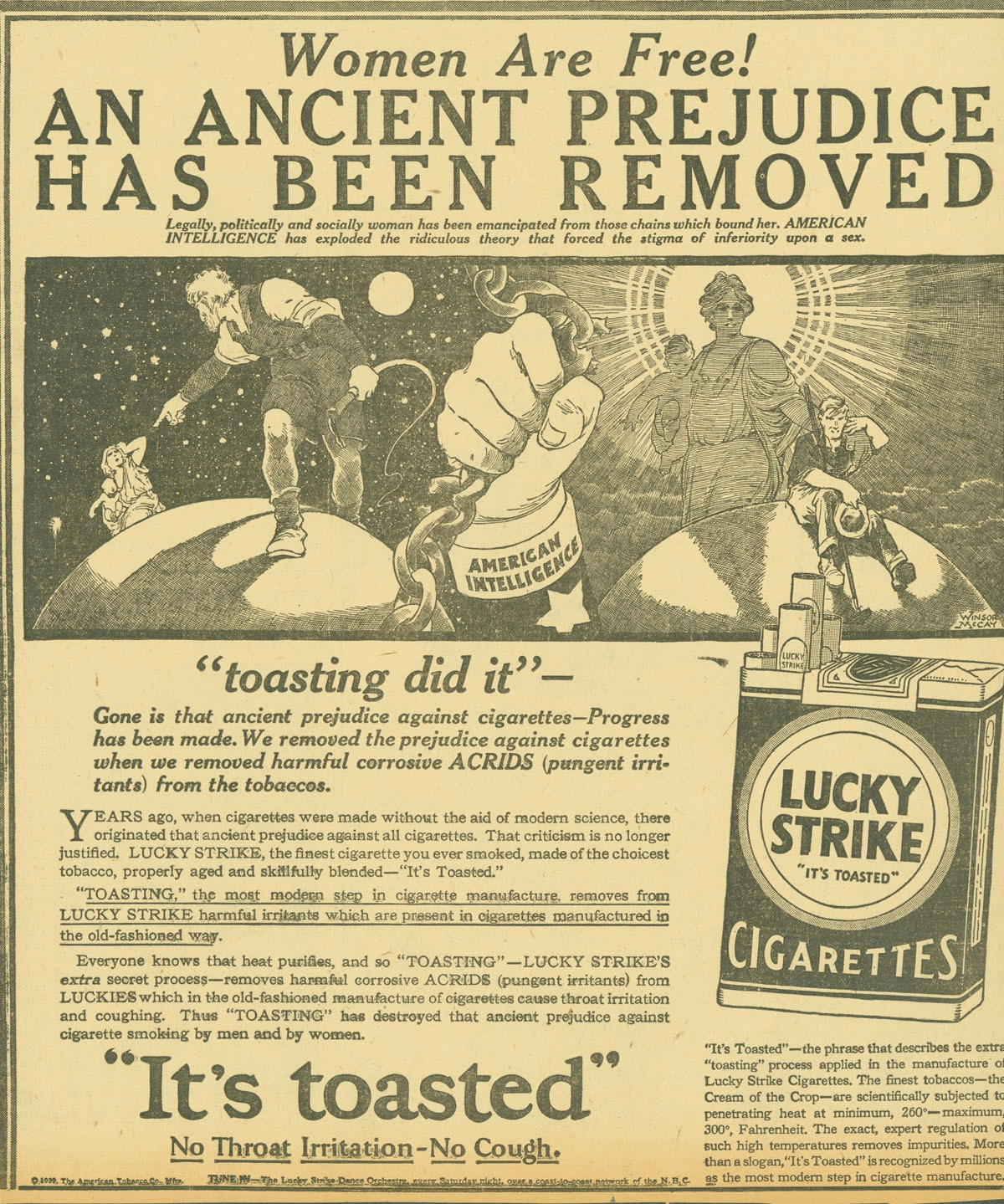
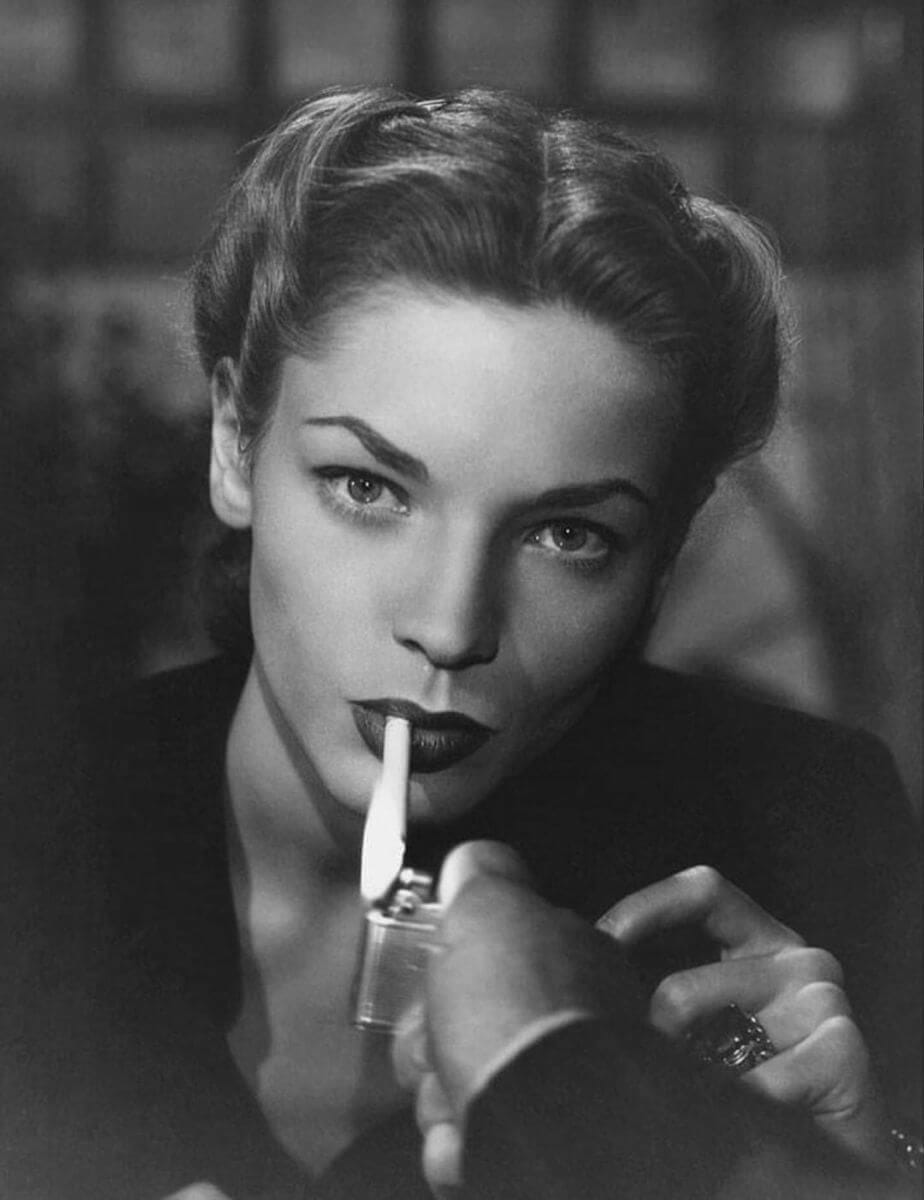
Hollywood quickly picked up on the symbolism. From the 1930s onward, the movie image of a woman with a cigarette became a cinematic shorthand for strength, allure, independence, and danger.
The sexual metaphor fell beneath the radar of the Motion Picture Production Code [1930-1960s] which prohibited overt displays of sex.
The imagery has persisted, and even today, when a female character lights up on screen, audiences unconsciously register authority and control. Some examples:
Film noir femmes fatales smoldered through clouds of smoke, cigarettes as much a weapon as their sharp dialogue.
Stars like Bette Davis and Lauren Bacall made smoking glamorous, turning it into a symbol of sophistication and control.
Even as late as Netflix’s House of Cards, Robin Wright’s character Claire Underwood is shown smoking to convey icy dominance.
The message: a cigarette in a woman’s hand doesn’t just mean nicotine – it means she is powerful, untouchable, and in charge.
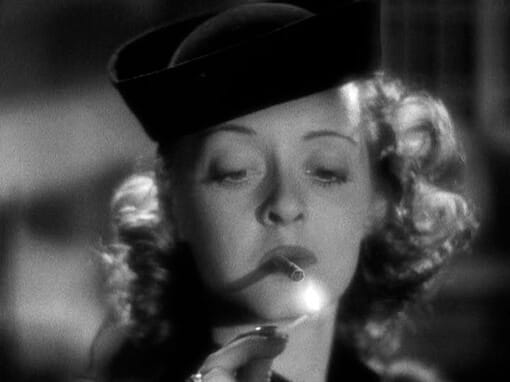
Women have embraced that iconic identity, much to their detriment with devastating health consequences.
This is the power of propaganda: it bypasses rational thought and plugs directly into emotion, desire, and identity.
Women bought cigarettes to have freedom, and all they got was addiction.
Bernays knew that people buy things because of the anticipated feeling of a product or behavior. Well-crafted manipulation makes it seem like a personal choice.
This principle works across all advertising and propaganda campaigns. It makes fortunes for corporations. It defines social norms and assures compliance with them.
The same psychological principles that Bernays used – linking products to identity, using symbols to create emotional connections, engineering "grassroots" movements – are still used by marketers and propagandists today.
Look through social media and news sites with a critical eye and you will see countless advertisements designed to appeal to emotions and identities.

As noted above, in 1917 Bernays worked for President Woodrow Wilson’s Committee on Public Information, designed to raise public support for American involvement in World War I.
Along with its director George Creel, they engaged thousands of volunteers known as Four-Minute Men. These speakers gave four-minute speeches at public gatherings around the country, promoting the war effort and encouraging enlistment of soldiers.
The four-minute limit was intended to align with the average person’s attention span. The campaign results speak for themselves.
There have been studies of late to show that the average human attention span has declined significantly over the years – down to a matter of seconds and less than a goldfish.
That may be extreme and perhaps faulty, yet doom-scrolling on social media platforms lends some credence to the idea that we are not paying attention to things very deeply. The fast pace of internet use and digital devices has indeed tampered with our ability to focus.
The Torches of Freedom episode was well-planned and choreographed.
Imagine how much more is entering our subconscious minds in the modern world that is well beyond our scrutiny.


References
The Birth of Corporate Feminism | Edward Bernays, Propaganda, Social Engineering
How Cigarettes Became A Symbol of Power In Film
Women Marched for the right to smoke? | UNTOLD HISTORY 1920's history
The man who BRAINWASHED America - Edward Bernays History Stories
A Brief History Of The Man Who Brainwashed America: Edward Bernays
Edward Bernays and the Art of Public Manipulation
Edward Bernays: Torches of Freedom (Case Study) | by Propaganda Studies
Torches of Freedom: How America Sold Cigarettes
You've Come A Long Way, Baby: Virginia Slims Advertising Year By Year - Flashbak
Average Human Attention Span Statistics & Facts [2024] | Samba Recovery
Why our attention spans are shrinking, with Gloria Mark, PhD
Average Human Attention Span By Age: 35 Statistics - Sedona Sky Academy

Hi, I'm Ellen...
... and I am a writer, coach, and adventurer. I believe that life is the grand odyssey that we make of it.
I would like to help you live a truly magnificent and happy life no matter your age and current situation.
You deserve to experience your hero’s journey to its fullest.
What are you waiting for?
There is only now and the next choice.
Subscribe to my email list here
your privacy is protected and you can unsubscribe any time
Subscribe to the Triumph and Grace newsletter
your privacy is protected - unsubscribe any time