
Triumph
and
Grace
Werewolves and Villagers
In 1987 Dimitry Davidoff, a psychology student at Moscow State University, created the social deduction game of Werewolf [originally called Mafia]. He proposed a thesis about human behavior that he set out to prove, using his game as the medium.
In a group of 8-20+ players, there is a conflict between the werewolves and the villagers – roles that are assigned secretly. The game involves strategic thinking, deduction, debate, and discussion.
The villagers win if all the werewolves are eliminated, and the werewolves win if their number equals or surpasses the number of villagers.
Davidoff introduced the game into the psychology department classrooms for his research, and it spread to the dormitories and summer camps from there, as it became increasingly popular, and was soon found in colleges and schools across the country.
By the 1990s it had spread to parts of Europe and the United States.
It is safe to say that Dimitry Davidoff did in fact prove his thesis. His game of Werewolf is truly a profound exploration of social dynamics, group behavior, deception, and information manipulation.
So, what was his supposition? Before we get into that, let’s look at the game itself to see if you can guess its significance.

To begin, a Moderator distributes cards [or slips of paper] face down to each member of the group – either a villager or a werewolf. There are generally 2 werewolves, but in a larger group there may be 3 of them.
The Moderator will know who has what roles.
For each round of play, there is a night phase and a day phase.
At the command of the Moderator, when it is night, all the participants close their eyes and put their heads down.
The werewolves open their eyes and silently identify one of the villagers to “kill.”
The Moderator “wakes up” the group for the day phase and indicates which villager is now gone.
During the day phase, the group discusses the situation and tries to determine who the werewolves are. They vote and the player with the most votes is eliminated, whether a villager or a werewolf.
The night and day phases continue until there is a winning team.
In more sophisticated versions of the game, there is a card deck with additional roles to add more nuance and complexity.
For example, the doctor card allows that player to spare an individual for a round.
The seer card allows that player to investigate another to determine if it is a werewolf.
The mayor card gives that player double votes.
The hunter card allows that player to “shoot” another for immediate elimination.
Werewolf can be played at in-person parties and gatherings or virtually via Zoom or Google Meet.



Dimitry Davidoff contended that an informed minority [werewolves] pitted against an uninformed majority [villagers] would usually win.
The werewolves are the “knowing few” and the villagers must rely on guesswork. When a small group has hidden information, it can manipulate a large group of people.
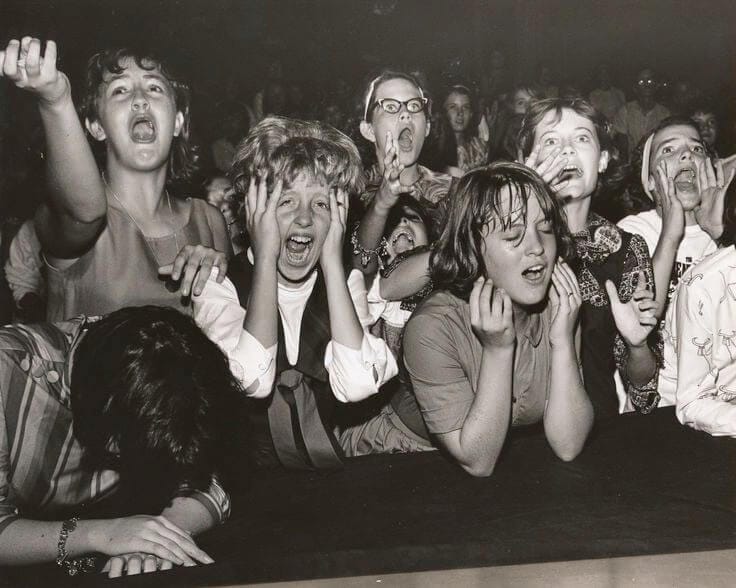
This social deduction game puts a spotlight on the complex phenomena of groupthink and mass hysteria, as it exploits the primal human need for safety and belonging.
Groupthink is the psychological phenomenon that prioritizes group consensus and harmony over individual opinion, diversity, and analytical reasoning. It generally leads to unfortunate consequences.
In Werewolf, groupthink shows up among the villagers who lack information and must rely on each other for survival. There will be pressure to agree on who the werewolves are, and many will comply despite internal doubts.
Mass hysteria manifests via collective irrationality and panic. Limited information again can lead to blind accusations and poor decision making.
Group behavior replays repeatedly – once fear and unchecked suspicion take over a group, the truth is buried, and critical thinking is impossible.
Werewolf is only a game, but it highlights the human impulse to succumb to emotions in the face of uncertainty. Safety and social acceptance become more important than rigorous analysis.
It serves as a method for exploring complex social dynamics and behaviors. From there we can gain insights into real-world situations where there are similar challenges and strategies at work.
Human behavior in group settings is very different from individual behavior – these are important to understand.
Keep in mind the biggest takeaway: The uninformed majority nearly always loses the battle of information against an informed minority.

References
The Werewolf Game: A Masterclass in Social Influence & Strategy
How to Play Werewolf (Party Game): Setup and Rules
Werewolf Game Rules, Roles & How to Play
How to play Werewolf (Party Game) | Official Game Rules
The Ultimate Werewolf Game Rules Guide: How to Play Like a Pro
Character Roles – WEREWOLF by Stellar Factory
Game Description | Werewolf the Game Wiki | Fandom

Hi, I'm Ellen...
... and I am a writer, coach, and adventurer. I believe that life is the grand odyssey that we make of it.
I would like to help you live a truly magnificent and happy life no matter your age and current situation.
You deserve to experience your hero’s journey to its fullest.
What are you waiting for?
There is only now and the next choice.
Subscribe to my email list here
your privacy is protected and you can unsubscribe any time
Subscribe to the Triumph and Grace newsletter
your privacy is protected - unsubscribe any time